New – Product Bundle Overview!
Click on the tab and download the Overview Pdf. Share with your colleagues. Contact Us if you have questions about the Skillstreaming Product Bundles.
New – Product Bundle Video will help you see how the Skillstreaming products work together!

Skillstreaming is a prosocial learning program designed to help children and youth learn positive ways to have their needs met.
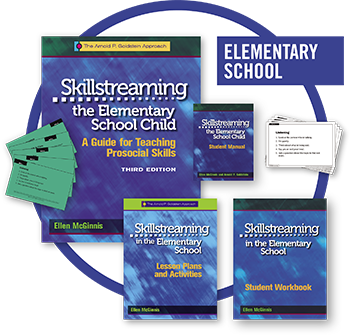
Skillstreaming the Elementary School Child employs a four-part training approach—modeling, role-playing, performance feedback, and generalization—to teach essential prosocial skills to elementary school students.
What’s Included:
Program Book – This book provides a complete description of the Skillstreaming program, with instructions for teaching 60 prosocial skills.
Adaptable for a variety of situations, Skillstreaming is ideal for small group instruction for children who have common social needs. Often used by counselors and others, the Skillstreaming program is structured to be a targeted, social-emotional learning intervention. Specific Skillstreaming skills can also be taught in whole class sessions by counselors.
Skill Cards – Convenient 3×5″ cue cards designed for student use during group sessions and homework assignments. The cards list the behavioral steps for each of the 60 skills contained in the Skillstreaming the Elementary School Child program. Eight cards are provided for each individual skill, for a total of 480 skill cards.
Lesson Plans and Activities – This comprehensive resource provides the materials needed to sustain skill instruction, enhance students’ skill mastery, and most important – to refine skill use for dealing with more complex, real-life situations in and outside of the classroom. The 312-page manual features 600 easy-to-use lesson plans and related activities. The manual includes numerous reproducible forms and worksheets available as a download.
Student Workbook (packet) – The workbook helps children move from classroom modeling to real world mastery of the 60 prosocial skills introduced in the instructional curriculum Skillstreaming the Elementary School Child. Thirty new activities help students learn to generalize and refine social-emotional skills such as making friends, dealing with their feelings, alternatives to aggression and coping with stress. The 10 Student Workbooks and a Leader’s Guide give educators, clinicians, and school counselors a step-by-step procedure for introducing and proceeding with the Skillstreaming program. The numerous activities provided in the Student Workbook assist students in not only learning the Skillstreaming process, but key social nuances that will help them be more successful in their skill use. Each packet contains 10 student workbooks and a Leader’s Guide.
Student Manual (each) – This clear and concise manual is written for the elementary school student and fully explains the Skillstreaming four-part training approach, which helps to reduce anxiety about learning new social skills in a group setting. This guide is helpful to parents and guardians who can better support the student when practicing the skills and completing the necessary homework assignments.
Skill Posters – A set of 60 posters (18×12″) displaying the behavioral steps in each of the skills in the Skillstreaming the Elementary School Child program. A great tool for reinforcing the skills they’re learning!
Shown below is episode two of Prosocially Yours, a podcast produced by Research Press. In this episode, host Elizabeth Hess interviews educator and author, Dr. Ellen McGinnis, about the widely acclaimed Skillstreaming program.
Praise for the Skillstreaming series
“The third edition of the Skillstreaming series is my first choice as the go-to resource for a research-based, user-friendly, and level social skills curriculum for professionals in all settings serving children and youth.”
Sheldon Braaten, PhD,
Founder and Executive Director,
Behavior Institute for Children and Adolescents
“There are a multitude of social skills programs on the market. . . . This program cuts out the gimmicks, and hammers home what is really needed: Identify the skill that is missing in the student, model it for the student, role-play it with the student, and provide opportunities for them to generalize it to real life situations.”
Nan Gordon, Communiqué
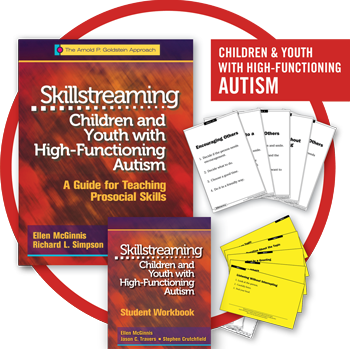
“McGinnis and Simpson led the way for social skill intervention for individuals on the autism spectrum with the innovative program book The Skillstreaming: Children and Youth with High-Functioning Autism: A Guide to Teaching Prosocial Skills.
Research Press has just released the Student Workbook and the Student Workbook Group Leaders’ Guide that accompanies the program. This is exciting for the field of autism—practitioners who work daily with children and youth and students who struggle with excesses or deficits in social skills. The detail of lesson plans, scenarios and activities which these two supplemental books were designed will enhance the program effectiveness and certainly support practitioners’ abilities to implement lessons with high fidelity! This translates to improving the skills of their students/clients to achieve social success and all the benefits of full inclusion in their social world and the community in which they live.
As I reviewed these books the first thought I had was how helpful they would have been during my teaching years. As a teaching professor I know how important they will be for every teacher and related service provider whom I teach and mentor. Thank you to Dr. McGinnis for continuing the vision that you and Dr. Simpson shared. Also, a special appreciation to our colleagues Jason Travers and Stephen Crutchfield for stepping up to continue this critical work!”
-Deborah E. Griswold, PhD, assistant professor for practice in the Department of Special Education at the University of Kansas
“Social skills are essential to navigating the complexities of everyday routines, accessing important reinforcers, and developing meaningful and lasting relationships. Unfortunately, some of us have difficulties acquiring extensive and flexible social skills repertoires, especially given recent events that have impacted the way we interact with each other daily. In this important resource, McGinnis and colleagues provide guidance on teaching social skills in ways that are relevant, person-centered, and dignifying to autistic learners. This powerful tool, though directed to those serving autistic students, is broadly applicable and should be on the shelf of every classroom teacher.”
-Robert Pennington, Lake & Edward J. Snyder, Jr. Distinguished Professor in Special Education, Department of Special Education and Child Development, University of North Carolina Charlotte
“The Skillstreaming Group Leader’s Guide and Student Workbook are the perfect companions to the Skillstreaming learning procedures. These materials bridge the science-based information from Skillstreaming instruction so that students, teachers, and families can access and apply this quality social skill instruction in meaningful and effective ways. The authors combine sound research-based strategies with their direct knowledge of teaching students with high-functioning autism. The result is a set of tools that are relevant, engaging, and promote generalization and maintenance of skills over time. Well done!”
-Leah Wood, PhD / BCBA-D, Associate Professor / Cal Poly School of Education, Co-Coordinator / Special Education Masters and Credential Program, Co-PI of TIER / Teaching for Inclusivity and Equity Residency, President / Division on Autism and Developmental Disabilities
“I have been a fan of the Skillstreaming series for years. When I was first starting out as a special education teacher, I found the series to be the best version of social skills programming for helping children understand the complex world of social development. After 20 years of using Skillstreaming with my students with autism and behavior disorders, I believed that I was an expert in my approach to using the curriculum. It became clear after reviewing the workbook and group leader’s guide that I was just scratching the surface. McGinnis, Travers, and Crutchfield created an incredibly powerful tool with this material. They showed me ways that I had never thought of using the curriculum and this has improved my ability to provide a richer and deeper understanding of social development for my students. This is an easy-to-use guide and a leap forward in enhancing the Skillstreaming curriculum. For anyone looking for a powerful social skills program for children with high functioning autism, they should look no further!”
-Matt McNiff, Ph.D., Behavior Consultant and Director of Special Education for Educational Service Unit #5
Author Spotlight – Skillstreaming
Summer of 2020
Dr. Ellen McGinnis began teaching and adapting the Skillstreaming curriculum shortly after learning about it from Dr. Arnold Goldstein, whose research originated this prosocial, evidence-based curriculum. Skillstreaming can be taught to vast age groups—from early childhood through adolescence—by teaching and practicing positive social skills.
Let’s start at the very beginning. How did you first get involved with Skillstreaming?
At the time, I was a consultant to public school-based classrooms for students with behavioral disorders. I heard Professor Goldstein present the Skillstreaming program at the International Conference for Exceptional Children in New York City shortly after Skillstreaming the Adolescent book was published. Even though I consulted primarily with elementary classrooms, the program made such good sense to me that I ran out and purchased the book.
Because the specific skills were geared to the adolescent learner, I modified the skill steps and created new skills for the elementary age group. The learning procedures were applicable to all age groups so the new skills were taught in the same manner as in Skillstreaming the Adolescent. One elementary teacher was excited about the information I shared with her and together we implemented Skillstreaming, teaching the elementary skills, creating new skills based on the needs of this age group, and modifying the homework assignments. Generalization of the skills was an important focus for us and we soon had others in the schools, from cafeteria workers to general education teachers, asking us what we were doing to make such a positive impact on the students’ behaviors. We then shared the information at an all staff meeting at the school. I recall one general education teacher specifically who took our information and within days began implementing Skillstreaming with her students!
When did you first begin collaborating with Dr. Arnold P. Goldstein?
After about a year teaching the skills, word spread about using this approach with elementary students and the teacher and I were asked to give presentations about the revised Skillstreaming program. I was happy to do this but felt a bit uncomfortable doing so without permission from Professor Goldstein. So, I called him. As we talked, he requested I send him the information I had developed for his review. Thus, our collaboration began.
(Later on, when my daughter was enrolled in a preschool/daycare setting that encouraged parents to volunteer, I carried out Skillstreaming groups with the children attending this center. This experience became the basis for Skillstreaming in Early Childhood.)
How did Dr. Goldstein involve colleagues in the creation and evolution of the Skillstreaming program?
Professor Goldstein was committed to research verifying specific strategies; among these was Structured Learning, the precursor to Skillstreaming. He conducted much of the research himself or through his students at Syracuse University. Even with the importance he placed on evidence- based practices, he reached out to colleagues whose primary emphasis was on practice. When much of his research was published, he included and relied on these colleagues to help put the researched methods into practice.
Professor Goldstein is credited for the creation of Skillstreaming (Structured Learning) based on social learning theory. He also conducted and reported on a large amount of research showing the success of this approach and areas of needed concentration (e.g., generalization strategies) to enhance its effectiveness. He, along with Robert Sprafkin and Jane Gershaw, both professors at Syracuse University, and Paul Kline a director of school for students with emotional and behavioral disorders, were co-authors of the first Skillstreaming book, Skillstreaming the Adolescent, published in 1980.
Professor Goldstein later collaborated with Barry Glick and John Gibbs in teaching select Skillstreaming skills as part of a program, Aggression Replacement Training, or ART, to reduce aggression in youth served by the juvenile justice system. With strong evidence in creating behavior change for this population of youth, ART, along with Skillstreaming, is currently being implemented throughout our nation and beyond.
What are the basic goals of the Skillstreaming program
Skillstreaming is a social-emotional learning program designed to help children and youth learn positive ways to have their needs met.
Depending on specific student needs, individuals learn the following skills: classroom survival skills, such as how to ignore distractions; skills for dealing with stressful times in their lives; and skills to deal with their feelings, as well as solving problems in assertive rather than aggressive ways. The main goal is to increase the choices students or clients have within their repertoire, hopefully leading to more satisfying and productive lives.
Skillstreaming evolved from Dr. Goldstein’s research in mental health strategies during the de-institutional movement of the 1960’s (removing mental health patients from institutions). The movement focused on implementing a behavioral approach to treatment in lieu of “talk therapy”. Therefore, achieving the goal of learning skills in these areas relies on a behavioral approach. In other words, individuals are exposed to the steps to the specific skills in these areas, observe these steps in a variety of situations relevant to the needs of the individual, and then practice the skills in simulated situations. In summary, the focus of Skillstreaming is on modeling, role-playing the skill, receiving feedback related to their practice attempts, and then trying out the skill in real life situations. Thus, individuals aren’t expected to learn these skills by just talking about what they could do.
How have other people, i.e. colleagues, contributed through training? (e.g. Sheldon Braaten and others).
Skillstreaming is a well-validated and easily implemented program. Therefore, many school districts have local professionals who provide this training. One example of this is Des Moines Public Schools, which provides training through behavior interventionists such as Shawnda Goerish. When this is not the case, school districts seek assistance through professionals such as Dr. Sheldon Braaten who is the main Skillstreaming trainer on a national level. Dr. Jason Travers, from the University of Kansas, provides training in applying the Skillstreaming learning principles to youth with High Functioning Autism. These trainers can be contacted through Research Press, the company that publishes the Skillstreaming series.
How flexible or adaptable is the Skillstreaming program to meet the needs of school counselors?
This is a good question. Skillstreaming certainly lends itself to adaptation by school counselors and other school support personnel. Because the specific skills included in this program are helpful for most students to learn, this program can be implemented by counselors who conduct whole class sessions as a universal intervention. Small group instruction for students who have common social needs is often used by counselors and others as a targeted, social-emotional learning intervention. Finally, students who need more intense intervention benefit from Skillstreaming instruction as a part of their behavior intervention planning.
What are the newest developments in the Skillstreaming series?
First, due to the interest of professionals serving youth with Autism disorders, Skillstreaming was adapted to meet specific needs of this population. Doing so resulted in the development of Skillstreaming of Children and Youth with High Functioning Autism. This manual takes into consideration the specific characteristics of this population including learning a small amount of information at one time, providing adult coaching, and including non-disabled peers as supports in both instruction and generalization.
Another development in Skillstreaming is the creation of Lesson Plans and Activities books. The rationale for this development is to create easily implemented activities to reinforce the skills being taught through this approach and to do so in academically friendly ways. The goal is to provide a variety of activities to support long lasting skill learning. The Skillstreaming in the Elementary School version is new and is already available. The Early Childhood Lesson Plans and Activities was published just this summer, and the Skillstreaming the Adolescent Lesson Plans will be available soon.
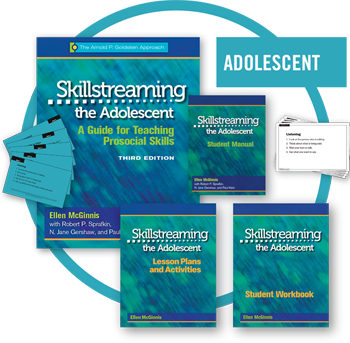
In response to teachers and other leaders of Skillstreaming groups wanting more direction in implementation of Skillstreaming, newly created “workbooks” to guide instructors in teaching the Skillstreaming learning procedures to their students have been developed. The workbooks for both Elementary and Adolescent students were written to create more interaction between students and teachers and to emphasize the social nuances not directly addressed in the Skilstreaming texts.
What questions do you get from teachers, counselors and therapists when they use the program?
Perhaps the most frequent question relates to how long they should spend instructing on a single skill and when they should move on to teaching another skill. Unfortunately, there is no simple answer here. This is dependent on the complexity of the skill and how often the students use the skills when real-life situations arise. In other words, when students begin to generalize their skill learning, it’s then okay to move on to learning other skills. However, it is important to periodically review, reinforce, and monitor the previously learned skills.
Another question we often receive from counselors and therapists is how best to generalize Skillstreaming to the general education setting. The most comprehensive answer to this question is to teach the same skills the student is learning in the therapeutic setting in the general classroom as well. The skills learned by the target students are unlikely to generalize to other settings unless both teachers and peers have an understanding of the skills themselves and how to appreciate the target students’ skill use. I have found it most useful for the counselor or therapist to co-lead the Skillstreaming sessions with the general education teacher as a co-leader.
Is there a targeted group of children or adolescents who you think benefit the most from Skillstreaming?
This is an excellent question. Initially it was believed that Skillstreaming was not appropriate for certain populations, such as individuals with Autism. However, research has shown that it is indeed effective for this population. Others believed that the program was designed only for students with behavior disorders, and I used Skillstreaming as an on-going intervention with this group. While Skillstreaming has a positive impact for this group of individuals, it is also helpful to general education students. Again, I used Skillstreaming with my own children and continue to use the program with my grandchildren. Certainly, all youngsters are not automatic in their problem solving nor do they instinctively know how to deal effectively with everyday stressors. We know this from our common knowledge of the typical struggles of teenagers and the increased number of children, from preschool through college age, who experience a high level of stress.
This program is also recommended for more seriously involved youth, such as those with mental illness or other significant disabilities, Skillstreaming is useful as a part of their intervention program. Other strategies or therapies must be included as well.
So, instead, the real question has become “how can we make Skillstreaming effective for different populations?” And, because Skillstreaming is “good teaching,” it is the same question we ask for academic instruction—Do the students need more intense instruction? Do they need the instructions for a longer period of time? Do they need the skills broken down further to be more successful? Does the instruction need to begin earlier before they experience a pattern of failure? Do they need interventions in addition to Skillstreaming? These are the questions that need to be asked.
Conversely, what do you hear from the providers who administer Skillstreaming?
Overall, I hear very positive feedback from administrators. For instance, one example can be illustrated from a teacher who carried out Skillstreaming with her adolescent students with behavioral disorders in an inner-city high school in the Midwest. The assistant principal questioned the teacher regarding the reason she hadn’t seen the teacher’s students in her office lately for disciplinary infractions. The teacher calmly responded that she was confident in dealing with the students’ behavioral concerns through teaching them alternative skills, prompting their skill use, and reinforcing their positive choices; therefore, she didn’t need the assistance of the assistant principal. Additionally, this teacher included her students in a general education social studies class, conducting the Skillstreaming group with the total class, using the social studies teacher as a co-leader of the group. The social studies teacher later stated to the school principal “this stuff works!” Actually, showing the outcome in improved student choices is the most effective way to gain administrative support for the program.
How do you continue to adjust Skillstreaming as the needs of participants evolve?
We need to continue to rely on feedback from both practitioners and researchers. For example, teachers’ comments concerning their need for more variety in instruction of the skills led to the development of the Lesson Plans and Activities. Teachers’ requests for increased guidance in teaching Skillstreaming led directly to the creation of the Skillstreaming workbooks.
Twenty years ago, research questioned the effectiveness of social skills training. Yet, the research also revealed that the skill training occurred for only a limited time (typically six weeks) before results were measured. New results were later revealed that suggested social skills learning largely related to the intensity of instruction (such as the length and frequency of sessions) and the length of time instruction was carried out. We also learned that fidelity of implementation, or implementing the intervention as it was designed, was a critical factor in student performance. The latter led to the inclusion of the Implementation Checklists for practitioners.
In other words, we need to continue to listen to both those implementing Skillstreaming and those researching the success of implementation to continue to adapt to best benefit those individuals who benefit from this instruction.
Is there anything else you would like to add to this discussion?
There is one thing. In a sense, Skillstreaming has become “a way of life” for me as a teacher, as a school administrator, as a parent, and as a grandparent. By this I mean that the first thing I think of when a child makes a poor choice or “misbehaves” is this: perhaps they need to learn a skill to deal with this issue. I no longer think first of punishing or delivering consequences. I think first of teaching a skill.
When I was first trained in behavior management, I learned to reinforce the positive behavior when it occurred and provide a negative consequence when misbehavior happened. Yet, I had to wait until a positive action happened, which sometimes took a while. As a teacher, it seemed I was using so many negative consequences that had a negative impact on our classroom culture. After learning and integrating Skillstreaming into “a way of life,” I realized my students, my children and grandchildren were only acting in the way they knew how to act. It was my job as a teacher and parent to teach. Skillstreaming gave me this option.