Sale!

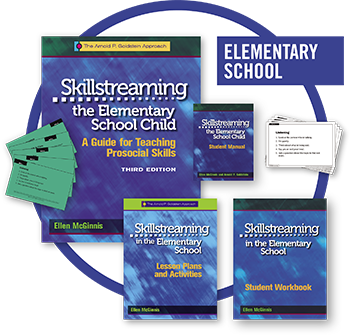
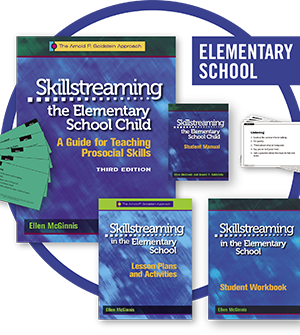
Skillstreaming the Elementary School Child - Program Book & Training DVD

Program Book and Training DVD Set
n/a
ISBN: 9780878227488
Item Number: 7003

Original price was: $162.98.Current price is: $122.23.You save $40.75 (25%)

- +

New Skillstreaming Set! – Program Book and Training DVD!

Skillstreaming is a prosocial learning program designed to help children and youth learn positive ways to have their needs met.

Skillstreaming the Elementary School Child employs a four-part training approach—modeling, role-playing, performance feedback, and generalization—to teach essential prosocial skills to elementary school students.

This book provides a complete description of the Skillstreaming program, with instructions for teaching 60 prosocial skills.

Adaptable for a variety of situations, Skillstreaming is ideal for small group instruction for children who have common social needs. Often used by counselors and others, the Skillstreaming program is structured to be a targeted, social-emotional learning intervention. Specific Skillstreaming skills can also be taught in whole class sessions by counselors.

The Skillstreaming program at every age level is designed to be easily implemented when conducted by a group leader who has experience in working with small groups. Training is also available for school districts and other organizations when Skillstreaming will be implemented through multiple practitioners.

Skill Cards, Student Workbooks and Skill Posters reinforce the key objectives in the Skillstreaming program.

NOTE: It is essential for successful implementation of this curriculum to first have the program book (Skillstreaming the Elementary School Child: A Guide for Teaching Prosocial Skills) before attempting to utilize other Skillstreaming products.

Learn more about the Elementary program book here.


Skillstreaming the Elementary School Child: People Skills: Doing ’em Right (Training DVD), Second Edition

This second edition video reinforces the ideas of the evidence-based Skillstreaming program while highlighting exercises for elementary-aged children.

This video teaches People Skills—ways we can get along better with our friends, our parents, and even teachers, too. The instructor guides kids through skills that will help them stay out of trouble and help them manage their feelings. Social behaviors are skills, and through the guided Skillstreaming steps, kids are taught to make better choices.

The kids in the video learn that new skills require following specific steps:

  • Knowing what to do (the Steps to the Skill)
  • How to do it (watching a Model)
  • Trying it out (Role Play), and
  • Finding out how well you did and what could make it better (Feedback), and (Practice).

In People Skills: Doing ‘em Right, the instructor breaks down how the skill steps should be followed in order. Everyone role-plays the skill in a real-life situation. The role play is most effective for learning if it appears as close to real life as possible. The purpose of the role play is for the main actor to be successful in following the skill steps (practice of the positive).

Adaptable for a variety of situations, Skillstreaming is ideal for small group instruction for children who have common social needs. Often used by counselors and teachers, the Skillstreaming program is structured to be a targeted, social-emotional learning intervention.

As showcased in the video, the instructor utilizes Skill Cards, Student Workbooks, and Skill Posters to reinforce the key objectives in the Skillstreaming program.

Video running time: Approximately 22 minutes.

Shown below is episode two of Prosocially Yours, a podcast produced by Research Press. In this episode, host Elizabeth Hess interviews educator and author, Dr. Ellen McGinnis, about the widely-acclaimed Skillstreaming program.
Figures and Tables
Preface
Acknowledgments

Introduction

Why Teach Social Skills?
What Is Skillstreaming?
Skills for Elementary School Children
Understanding Violence and Aggression
Included in This Book

PART 1
Skillstreaming Program Content and Implementation

Chapter 1—Effective Skillstreaming Arrangements

Group Leader Selection and Preparation
Student Selection, Grouping, and Preparation
Support Staff and Program Coordinator Roles
Specific Instructional Concerns
Instructional Variations

Chapter 2—Skillstreaming Teaching Procedures

Core Teaching Procedures
Steps in the Skillstreaming Session
Implementation Integrity

Chapter 3—Sample Skillstreaming Session

Introduction to Skillstreaming
Skill Instruction

Chapter 4—Refining Skill Use

Cognitive-Behavioral Strategies
Factors in Successful Skill Use
Skill Shifting, Combinations, Adaptation, and Development

Chapter 5—Teaching for Skill Generalization

Transfer-Enhancing Procedures
Maintenance-Enhancing Procedures

Chapter 6—Managing Behavior Problems

Universal Strategies
Targeted Interventions
Individual Interventions

Chapter 7—Building Positive Relationships with Parents

Parenting and Children’s Aggression
Parent Involvement in Skillstreaming
Levels of Parent Involvement

Chapter 8—Skillstreaming in the School Context

Violence Prevention
Schoolwide Applications of Skillstreaming
Integration in the Curriculum
Inclusion
Multi-Tiered Systems of Support
New Intervention Combinations

PART 2
Skill Outlines and Homework Reports

Homework Reports follow each skill.

Group I—Classroom Survival Skills

1. Listening
2. Asking for Help
3. Saying Thank You
4. Bringing Materials to Class
5. Following Instructions
6. Completing Assignments
7. Contributing to Discussions
8. Offering Help to an Adult
9. Asking a Question
10. Ignoring Distractions
11. Making Corrections
12. Deciding on Something to Do
13. Setting a Goal

Group II—Friendship-Making Skills

14. Introducing Yourself
15. Beginning a Conversation
16. Ending a Conversation
17. Joining In
18. Playing a Game
19. Asking a Favor
20. Offering Help to a Classmate
21. Giving a Compliment
22. Accepting a Compliment
23. Suggesting an Activity
24. Sharing
25. Apologizing

Group III—Skills for Dealing with Feelings

26. Knowing Your Feelings
27. Expressing Your Feelings
28. Recognizing Another’s Feelings
29. Showing Understanding of Another’s Feelings
30. Expressing Concern for Another
31. Dealing with Your Anger
32. Dealing with Another’s Anger
33. Expressing Affection
34. Dealing with Fear
35. Rewarding Yourself

Group IV—Skill Alternatives to Aggression

36. Using Self-Control
37. Asking Permission
38. Responding to Teasing
39. Avoiding Trouble
40. Staying Out of Fights
41. Problem Solving
42. Accepting Consequences
43. Dealing with an Accusation
44. Negotiating

Group V—Skills for Dealing with Stress

45. Dealing with Boredom
46. Deciding What Caused a Problem
47. Making a Complaint
48. Answering a Complaint
49. Dealing with Losing
50. Being a Good Sport
51. Dealing with Being Left Out
52. Dealing with Embarrassment
53. Reacting to Failure
54. Accepting No
55. Saying No
56. Relaxing
57. Dealing with Group Pressure
58. Dealing with Wanting Something That Isn’t Yours
59. Making a Decision
60. Being Honest

Appendix A—Program Forms

Appendix B—Program Integrity Checklists

Appendix C—Behavior Management Techniques

References
About the Author


Shopping Cart