
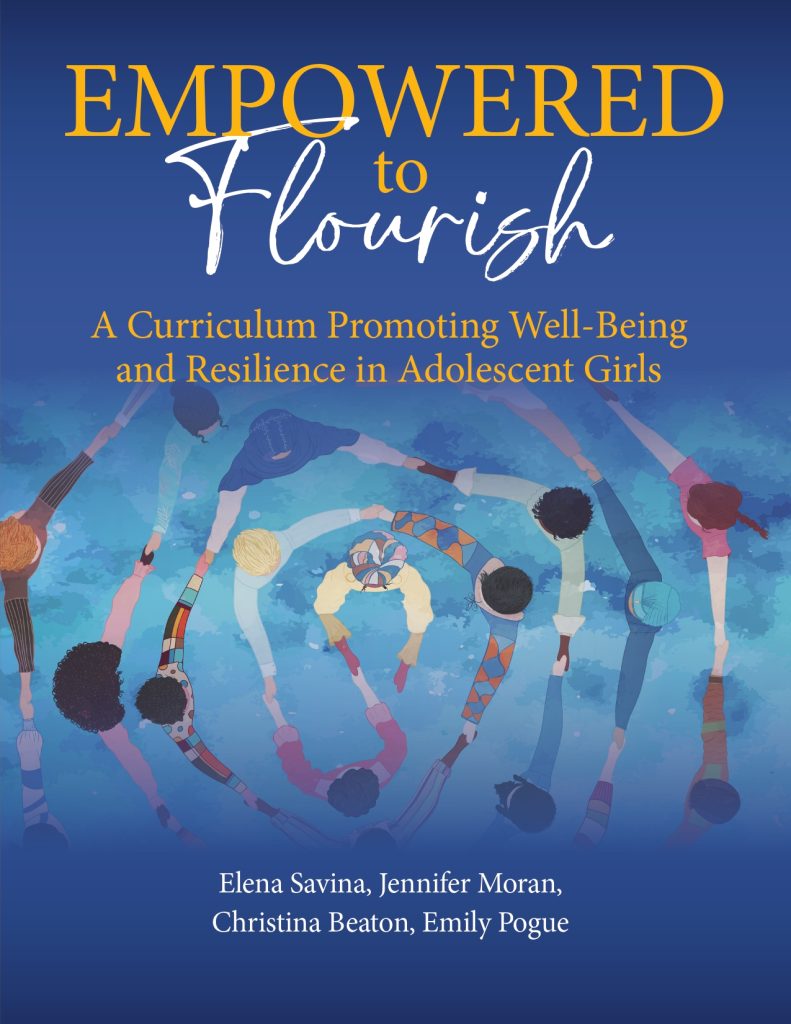
Research Press is proud to spotlight Empowered to Flourish: A Curriculum Promoting Well-Being and Resilience in Adolescent Girls, authored by Elena Savina, Jennifer Moran, Emily Pogue, and Christina Beaton.
Designed for counselors, teachers, and mental health professionals across public and private settings, this curriculum equips adolescent girls with the knowledge and skills they need to thrive during a critical stage of development.
- What inspired you to develop a curriculum specifically focused on empowering adolescent girls?
Elena Savina: Today, being a girl brings many challenges. Girls receive many conflicting messages from the media and pop-culture about femininity, sexuality, relationships, and the role of women. This affects girls’ emotional health, relationships, and self-esteem. Carol Gilligan, one of the pioneers in girls’ research, believed that adolescence is a critical time for girls’ development. This is when they can lose their voices and connection with others if they are unseen and unheard. That is why we developed a curriculum that could empower girls and help them to find their voice. This curriculum is also a response to a general decline in mental health and happiness in young people. We, mental health professionals, need to take a more proactive approach and equip girls with knowledge and skills for them to flourish.
Jennifer Moran: I’ve had the privilege of working with adolescent girls in both school and clinical settings, where I’ve seen firsthand the unique challenges girls face during this critical developmental stage. Many struggle with issues related to self-esteem, identity, body image, and peer pressure, often without adequate support or guidance. These experiences inspired me to become a member of the curriculum development team so we can help girls build their confidence, resilience, and a strong sense of self.
Emily Pogue: I was inspired by the resilience and potential I see in adolescent girls, alongside the need for targeted support to nurture their well-being during a critical developmental stage. Teen girls face unique societal pressures and challenges, and we wanted to create a resource to help them feel seen, supported, and empowered.
- How did the five domains (healthy habits and body image; emotional well-being; healthy relationships; purpose, values, and identity; and mastery, healthy coping, and resilience) shape the structure and content of the curriculum?
Elena Savina: The unique feature of the curriculum is that it is grounded in the integrative model of well-being in adolescent girls. In other words, it does not focus on a single component, such as emotions or body image, but targets all the components of well-being. This approach is supported by research which informs us that various components of health and well-being have synergistic effects on each other. That is why in order to make interventions successful, we need to focus on multiple well-being domains.
Jennifer Moran: These domains reflect a holistic approach to adolescent girls’ development. Each domain addresses a key area of growth, allowing girls to explore and strengthen different aspects of their well-being—from physical health and emotional regulation to self-identity and resilience.
- Which session or activity do you find most powerful or meaningful when facilitating groups, and why?
Elena Savina: I think it depends on the girls participating in the group. For some girls, learning about emotions is very relevant, for others – building healthy relationships. Regardless of the session content, the curriculum offers a very good balance of discussions, sharing, experiencing, and practicing that make it engaging and meaningful.
Christina Beaton: I found “My body” activities and discussions are very important. Adolescent girls are constantly receiving messages about how they should look or what they should do to improve themselves physically. It’s powerful to listen to other participants discussing their experiences with their bodies and to help girls feel not alone trying to navigate this difficult terrain.
- How do you see this curriculum addressing some of the unique pressures girls face today, especially around social media and identity?
Jennifer Moran: The curriculum addresses the unique pressures girls face today, especially around social media and identity. It encourages reflection on cultural influences and promotes healthy boundaries, resilience, and identity development in a world that often pushes unrealistic standards for girls.
Christina Beaton: The curriculum facilitates conversations about the pros and cons of social media and how social media may serve as a vehicle for getting needs met, either in a positive or negative way. It allows girls to explore their own relationships with social media and look at how social media may affect how they perceive themselves, others, and the world at large.
Emily Pogue: The curriculum fosters self-awareness, critical thinking, and emotional regulation, helping girls navigate social media and identity challenges with greater confidence and authenticity.
- What kind of long-term changes do you hope to see in girls who go through the program?
Elena Savina: I think the hopeful long-term outcome is already embedded in the curriculum title – we want girls not just to be free from mental health problems, we want them to flourish!
Jennifer Moran: I hope to see girls who complete the curriculum develop critical thinking, resilience, and confidence in themselves. The goal is to help them to navigate challenges with greater self-awareness, better decisions, and lifelong tools for personal growth.
Christina Beaton: I hope that the conversations and activities in the program, as well as the trust built between participants, help to develop girls’ perspective-taking and self-advocacy skills. I believe that these are all important skills that are needed throughout the lifespan that, if developed early, can continue to aid in identity and positive relationships.
- Your curriculum is designed to be used in both public settings as well as private practice. How did you ensure it would be adaptable across such different environments?
Elena Savina: The curriculum features various types of activities and addresses many important domains of girls’ functioning. That is why it suits the needs of many adolescent girls. In the school setting, the curriculum can be a great preventive intervention or be used for the group of girls with specific concerns. In private practice – it can enhance group therapy. Although therapy often focusses on mental health problems, adopting a strength-based approach featured in the curriculum can make therapy more successful. Furthermore, curriculum activities can be used in individual therapy. For example, it has many cool worksheets which can facilitate meaningful conversations with adolescent girls.
Jennifer Moran: The curriculum was designed with flexibility in mind—featuring modular content, clear facilitator guidance, and activities that can be easily scaled or tailored to different group sizes and timeframes. Such a structure allows professionals in various settings to adjust the material to fit their specific context while maintaining the core objectives.
Christina Beaton: The five well-being domains targeted in the program are applicable to any adolescent girls, regardless of where they receive services or what mental health concerns may be present.
Order your copy of Empowered to Flourish today!